The Myth of the Maintenance-Free Exterior
In twenty-five years of handling glass, from the heavy-duty demands of 60-minute fire glazing to the delicate balance of historic restoration, I have learned one hard truth: homeowners hate scrubbing glass. They want the performance of a high-efficiency unit without the labor of a squeegee. Most installers will sell you a window and walk away, leaving you to deal with the mineral deposits and environmental pollutants that bake into the glass surface under the relentless sun. But a window is more than just a view; it is a complex thermal boundary. If that boundary is obscured by dirt, your Energy Star window certification metrics start to shift, not because the glass failed, but because the solar gain and thermal absorption properties are being altered by a layer of grime.
A homeowner once called me in a panic because their expensive new windows were ‘sweating’ and looking ‘milky’ after only six months. I arrived with my hygrometer and a magnifying loupe. I didn’t see a seal failure; I saw a 65% humidity level inside a house where the occupant had bypassed the HRV system, and on the outside, a layer of calcium carbonate from a misplaced irrigation head. I had to explain that while the glass was fine, their lifestyle and maintenance routine were the culprits. It was the moment I realized that hydrophobic coatings aren’t just a luxury; they are a necessary component of modern water management. To understand why we are moving toward these coatings in 2026, we have to look at the glass at a molecular level.
“Installation is just as critical as the window performance itself. A high-performance window installed poorly will fail.” – AAMA Installation Masters Guide
The Physics of the Hydrophobic Bond
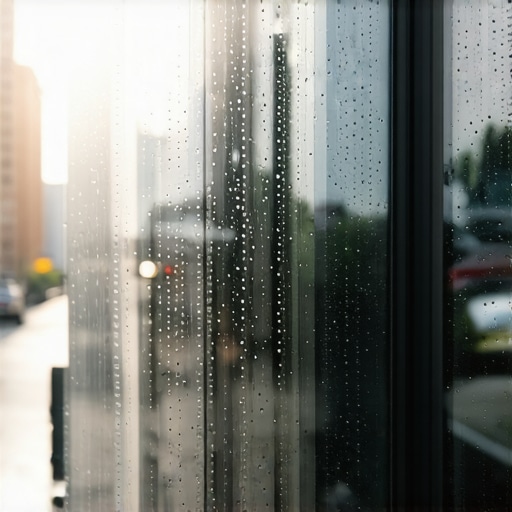
Standard float glass is naturally hydrophilic—it loves water. Water flattens out on the surface, creating a film that traps dirt and minerals. In the sliding window services industry, we are seeing a shift toward factory-applied silica-based coatings. These coatings change the contact angle of water droplets. While a standard piece of glass might have a contact angle of 20 degrees, a hydrophobic surface pushes that past 90 degrees. The water beads up, and as it rolls off, it picks up dust, pollen, and pollutants. This is the ‘Lotus Effect,’ and it is essential for high-access areas like a roof window replacement or a gable window installation where manual cleaning is dangerous or impossible.
Fix 1: Integrated Nano-Coatings for Gable and Roof Windows
When dealing with a gable window installation, you are often looking at glass that is twenty feet off the ground. No one is getting a ladder out every month to clean those. The fix for 2026 is specifying a Titanium Dioxide (TiO2) coating that works in two stages. First, it is photocatalytic; it uses UV light to break down organic dirt. Second, it is hydrophilic (ironically) in a way that allows water to sheet off evenly, carrying the broken-down debris with it. However, in the north/cold climate, we focus more on the hydrophobic side to prevent ice adhesion. If water cannot stick, it cannot freeze into a thick sheet that puts stress on the glazing bead and the sash.
Fix 2: Retrofitting Vertical Sliders and Frame Systems
Many homeowners think they need a full replacement to get these benefits, but window frame repair and vertical slider repair can include a field-applied hydrophobic treatment. When I perform a vertical slider repair, I often find that the weep holes are clogged with silt. By applying a professional-grade hydrophobic coating to the bottom rail and the lower portion of the glass, we ensure that water moves toward the drainage system faster. This prevents the ‘ponding’ that leads to seal failure and rot in the rough opening. During a repair, we shim the unit to ensure it is perfectly level, but even a level window will fail if water tension holds moisture against the sill pan.
“The NFRC rating provides a reliable way to determine if a window will meet the energy demands of its specific climate zone.” – NFRC Performance Standards
Fix 3: Fire Glazing and High-Performance Maintenance
60-minute fire glazing is a different animal. This glass is thick, heavy, and often contains intumescent interlayers. It is an expensive investment. The 2026 fix involves using hydrophobic coatings that are chemically stable at high temperatures. You do not want a coating that will smoke or degrade during a thermal event. By keeping this glass clean through hydrophobic action, you ensure that the glass can be inspected for internal delamination or bubbles without having to clear away years of industrial film. This is particularly important in commercial settings where sliding window services are used to maintain egress points.
Fix 4: Voice Activated Windows and Sensor Protection
As we move toward voice activated windows, we are introducing more electronics into the frame. These systems often rely on optical sensors to detect if the operable sash is clear of obstructions. If the glass is filthy, these sensors can trigger false positives, preventing the window from closing or opening. A hydrophobic coating ensures the sensor path remains clear. In a north/cold climate, this also prevents frost from forming over the sensor eyes, which is a common failure point for smart window tech in places like Minnesota or Chicago. When I install these systems, I emphasize that the Energy Star window certification is only part of the equation; the tech needs to see to work.
The Glazier’s Final Verdict
Whether you are looking at a roof window replacement or just standard sliding window services, the goal is to manage the environment. In cold climates, we prioritize the U-factor, often using triple-pane glass with Low-E coatings on Surface #3 to keep the heat inside. Adding a hydrophobic layer to Surface #1 (the exterior) is the finishing touch that protects the entire assembly. Do not let a salesman talk you into ‘self-cleaning’ glass without explaining the chemistry. Ensure your installer uses flashing tape and a proper sill pan, because a clean window that leaks into the wall is a failure. Maintenance in 2026 is about working smarter, using the molecular properties of the glass to keep your home efficient and your weekends free from the ladder.