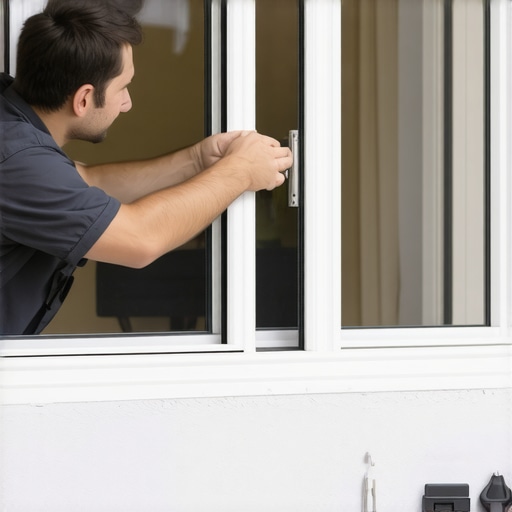
The Invisible Gap: Why Your Security Starts with Installation Science
In my twenty-five years as a glazier, I have seen every possible failure of the building envelope. Most people think of a window lock as a simple mechanical latch, but to a professional, it is the final point of compression in a complex thermal and structural system. If that lock does not engage perfectly, your high-performance vinyl window replacement is nothing more than an expensive, leaky hole in your wall. I once walked into a residence where the owner complained about a persistent whistling sound and drafty conditions near their high-end clerestory window lighting. They assumed the lock was simply cheap. I pulled out my thermal imaging camera and showed them the reality: the entire frame had bowed because the original installer neglected to use proper shims at the lock height. The resulting gap was allowing a convective loop to pull freezing air directly into the wall cavity, leading to interstitial condensation that was already rotting the rough opening. It was not a lock problem; it was an installation autopsy waiting to happen.
“Installation is just as critical as the window performance itself. A high-performance window installed poorly will fail to meet security and energy expectations.” – AAMA Installation Masters Guide
1. The Cam-Action Compression Hack
When we talk about security in 2026, we are talking about more than just keeping intruders out; we are talking about securing the thermal seal. Standard window handle replacement often involves cheap pot-metal latches that merely ‘hook’ the sash. A master hack is the use of cam-action locks. These are designed to pull the meeting rails together with significant force. When you rotate the handle, the cam geometry draws the operable sash into the bulb gasket of the frame. In a northern climate like Chicago or Minneapolis, this compression is what prevents the U-factor from skyrocketing during a polar vortex. If your lock does not require a slight bit of effort to close, you are not getting the compression needed to stop air bypass. This is especially critical for dormer window services, where wind loads are higher due to the roof’s pitch and elevation.
2. Reinforcing the Rough Opening for Strike Plates
A lock is only as strong as the material behind it. In many vinyl window replacement scenarios, the strike plate is simply screwed into the thin-walled vinyl chamber of the frame. This is a security disaster. To truly secure a home, the screws for your window locks must penetrate through the vinyl, through the shim space, and at least one inch into the structural jack stud of the rough opening. This transforms the lock from a plastic-to-plastic connection into a structural anchor. When performing window handle replacement or lock upgrades, I always swap out the factory half-inch screws for three-inch stainless steel fasteners. This ensures that even if a pry bar is applied, the force is transferred to the framing of the house, not the brittle glazing bead or the vinyl sash.
3. Integrating Child Proof Window Locks with Vent Stops
Security often conflicts with safety, but it does not have to. Modern child proof window locks should be integrated as dual-purpose vent stops. These are secondary locking mechanisms that allow the window to open only four inches. The hack here is to ensure these are metal-to-metal connections. Most factory vent stops are plastic tabs. Replacing these with aftermarket, recessed steel stops ensures that your clerestory window lighting or bedroom windows provide ventilation without compromising the security of the home. This is a critical component of professional dormer window services where the heights involved make child safety a primary concern. Properly installed stops also prevent the sash from being manipulated from the outside while in the ‘vent’ position.
“Air leakage through the fenestration assembly can significantly degrade the effective U-factor and lead to structural damage from hidden moisture.” – NFRC Technical Manual
4. Thermal Imaging as a Calibration Tool
You cannot manage what you cannot measure. One of the most advanced hacks for 2026 is using thermal imaging window leaks detection to calibrate your lock tension. After installing new hardware, I use a FLIR camera to look for purple ‘tongues’ of cold air at the meeting rail. If I see them, I know the sash is not seated correctly. This often requires adjusting the shims behind the strike plate to ensure the sash is perfectly square. A window that is out of square by even an eighth of an inch will never lock securely or thermally seal correctly. This level of precision is why we offer guaranteed performance on our installations. It is also a vital step when inspecting fixed skylight services, as the gaskets on overhead glazing are under constant pressure from gravity and need perfect alignment to remain watertight.
5. The 90-Minute Fire Window Protocol
In high-density urban areas or wildfire-prone zones, 90-minute fire windows are becoming standard. The locking hardware on these units is a different beast entirely. You cannot simply use standard hardware; the locks must be rated to maintain their integrity at temperatures exceeding 1,000 degrees. The hack here is ensuring the lock housing does not act as a thermal bridge. We use intumescent gaskets behind the lock plates. In the event of a fire, these gaskets expand, sealing the lock hole and preventing hot gases from penetrating the frame. When you are cleaning your windows during interior window washing, inspect these specialty locks for any signs of corrosion or movement, as the weight of fire-rated glass is significantly higher than standard double-pane units, putting more stress on the operable hardware.
Maintenance and the Science of Longevity
Securing your home for 2026 requires a shift in perspective. A window is a moving machine. Like any machine, it requires lubrication and adjustment. During your routine interior window washing, take a moment to look at the weep hole. If it is clogged, water will back up into the sill pan and eventually reach the locking mechanism, causing internal corrosion. A master glazier knows that a secure home is a dry home. By focusing on the physics of the rough opening, the metallurgy of the window handle replacement, and the precision of thermal imaging, you create a building envelope that is truly a fortress against both intruders and the elements. Never settle for a ‘caulk-and-walk’ installation; insist on the technical precision that your home deserves. [{“@context”:”https://schema.org/”,”@type”:”HowTo”,”name”:”How to Install High-Security Window Locks”,”description”:”A guide for professional-grade window lock installation focusing on thermal efficiency and structural integrity.”,”step”:[{“@type”:”HowToStep”,”text”:”Assess the rough opening and ensure the window frame is square using a laser level.”},{“@type”:”HowToStep”,”text”:”Install long-reach stainless steel screws through the strike plate into the structural jack studs.”},{“@type”:”HowToStep”,”text”:”Calibrate the cam-action lock to ensure full compression of the sash gaskets.”},{“@type”:”HowToStep”,”text”:”Verify the seal using thermal imaging to detect any air bypass or cold spots.”}],”totalTime”:”PT60M”}]
This article highlights some really critical points about window installation that are often overlooked. I especially appreciate the emphasis on thermal imaging as a calibration tool—it’s something I’ve started to incorporate in my own projects recently, and the results are impressive. Proper shimming and locking adjustment can really make a difference not just in security but also in energy efficiency. One challenge I’ve faced is ensuring that the lock mechanism remains effective over time, especially in harsh outdoor conditions. Have others found specific maintenance routines or hardware types that hold up better under weather extremes? I think routine checks, like inspecting weep holes and lock alignment, are vital for longevity. It’s clear that meticulous attention to detail during installation can save a lot of headaches later. Would love to hear more about how you all approach ongoing maintenance for these high-tech locks and thermal seals in your projects.