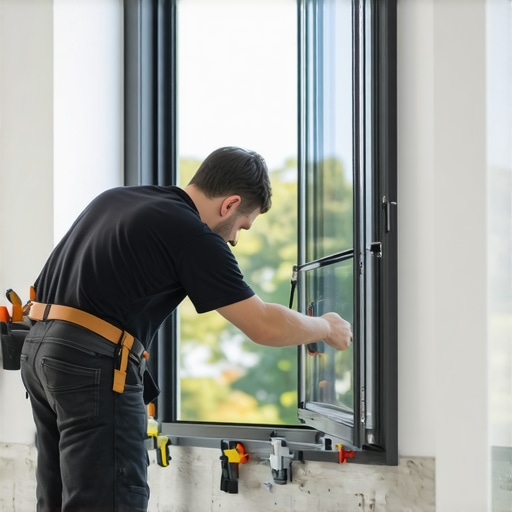
The Evolution of the Fenestration Opening
In my 25 years of standing in rough openings, I have seen every trend from the glass block craze to the minimalist slim-line movement. But as we look toward 2026, the pivot window installation has moved from a niche architectural statement to a high-performance necessity. A pivot window isn’t just a window; it is a heavy-duty piece of kinetic art that rotates on a central or offset axis. However, if you treat a 300-pound pivot sash like a standard vertical slider repair, you are inviting structural failure and water infiltration. I remember a specific project on the Carolina coast where a homeowner called me in a panic because their brand-new, oversized pivot units were ‘sweating’ and refusing to latch during a minor storm. I walked in with my hygrometer and thermal camera and found that the indoor humidity was hovering at 65%, and the installers had failed to account for the thermal bridge at the heavy-duty pivot hinge. It wasn’t just a condensation crisis; it was an installation failure that ignored the basic physics of coastal moisture management.
“Installation is just as critical as the window performance itself. A high-performance window installed poorly will fail.” – AAMA Installation Masters Guide
1. Structural Load and Rough Opening Tolerances
When dealing with pivot window installation, the first thing you must understand is the moment arm. Unlike a traditional casement where the weight is hung on a side jamb, a pivot window distributes its load across a specialized hinge located at the top and bottom or the sides. This requires the rough opening to be perfectly square and reinforced. I have seen too many ‘tailgate’ contractors try to install these using standard pine shims that eventually compress under the weight. For a pivot sash that might weigh as much as a small motorcycle, you need high-density plastic shims and a sill pan that can handle the point-load. Furthermore, if you are looking at window sill replacement prior to a pivot install, the new sill must be structurally integrated into the house framing, not just nailed to the sheath. The tolerance for a pivot window is often less than 1/8th of an inch across the diagonal; any more, and that 180-degree rotation becomes a grinding struggle that will eventually strip your window handle replacement hardware.
2. Hurricane Protection and High-Velocity Wind Zones
Since many pivot windows are being specified for coastal modern homes, hurricane window protection is no longer optional—it is a code-mandated reality. In 2026, we are seeing pivot units designed with laminated glass that meets Missile Level D impact ratings. This involves a sacrificial outer layer of glass and a polyvinyl butyral (PVB) interlayer that holds the shards together upon impact. In high-wind scenarios, the pressure on a large pivot sash is immense. The glazing bead must be deep enough to prevent the glass from blowing out of the frame under negative pressure. We don’t just worry about the glass breaking; we worry about the entire sash being sucked out of the building. This is where the ‘Shingle Principle’ of water management is tested. If your flashing tape isn’t layered correctly from the bottom up, the wind will drive water into the pivot mechanism, leading to internal rot that you won’t see until the floorboards start to buckle.
“The window installation shall be designed to provide a continuous water-resistive barrier from the exterior surface of the window to the water-resistive barrier of the wall.” – ASTM E2112 Standard Practice
3. Thermal Performance and UV Mitigation
A massive pivot window is essentially a giant hole in your thermal envelope. To make this energy efficient in a coastal or southern climate, we focus heavily on the Solar Heat Gain Coefficient (SHGC). For 2026, the standard is shifting toward Low-E coatings on Surface #2 to reflect infrared radiation before it even enters the glass. Many homeowners also opt for UV blocking window films to protect their interior finishes from the relentless coastal sun. When we talk about skylight window installation or large pivot units, we are looking at the Visible Transmittance (VT) as well. You want the light, but you don’t want the heat. Using argon-filled units with warm-edge spacers is the only way to prevent the perimeter of the glass from becoming a cold spot where condensation can form. If you are replacing an old unit, don’t just look at the price; look at the NFRC label. A low U-factor is great for Minneapolis, but in the South, a low SHGC is what keeps your AC bill from exploding.
4. Accessibility and Safety: ADA and Egress
One of the most overlooked aspects of modern fenestration is the rise of ADA compliant windows. A pivot window, because of its unique motion, can often be operated with minimal force, making it an excellent choice for universal design—provided the handle is located within the reach range of 15 to 48 inches from the floor. Additionally, if the pivot window is located in a bedroom, it must meet emergency egress windows requirements. This means a clear opening of at least 5.7 square feet and a minimum opening height of 24 inches. Not all pivot windows are created equal here; some center-pivot designs actually bisect the opening, making them useless for egress. You must specify a model that can lock out at a full 90 or 180 degrees to allow a firefighter with an air tank to pass through. Finally, don’t forget the interior; window blind installation on a pivot window requires specialized hardware so the blinds don’t flap around when the window is tilted. It’s all about the details—from the vertical slider repair skills you learned years ago to the high-tech glazing beads of today, a master glazier knows that every millimeter counts.
This post really highlights the complexity involved in pivot window installation, especially when it comes to coastal applications. I agree that proper structural support and Tolerance management are critical — I’ve seen too many cases where a small misalignment led to long-term issues like leaks and hardware failure. I particularly appreciate the emphasis on hurricane-rated glass; with climate patterns shifting, these are becoming essential even for homes not directly in high-wind zones. One aspect I find interesting is the focus on thermal performance and UV mitigation. Owners often overlook that massive pivot windows can be thermal bridges if not properly installed with Low-E coatings and argon fill. In my experience, combining those with well-thought-out shading solutions makes a noticeable difference in energy costs. Have others found specific brands or models that consistently meet these demanding standards for coastal climates? It seems choosing the right window is only half the battle; installation quality truly determines performance over time.