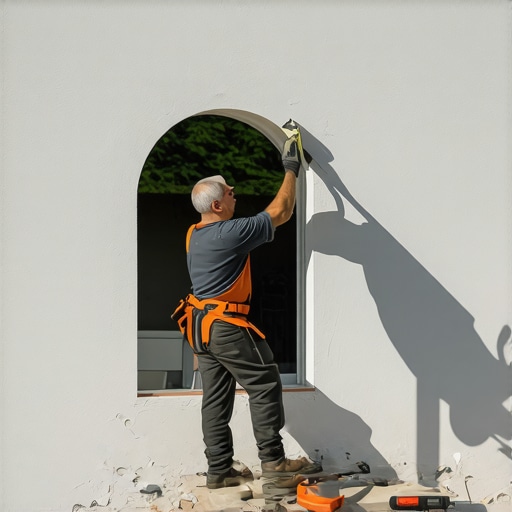
The Geometry of Failure: Why Arched Windows Are the Master Glazier’s Final Exam
I remember walking into a custom-built home three winters ago where the owner was nearly in tears. They had spent a fortune on a beautiful radius-top feature window, yet they were catching a quart of water a day in a bucket on their mahogany floors. They were convinced the glass was leaking. I pulled out my hygrometer and a thermal imaging camera, and the truth was far more clinical. The interior humidity was spiking at 55 percent, and the ‘professional’ installer had neglected to use a thermally broken frame for the arched segment. The cold from the exterior was migrating straight through the aluminum, hitting the dew point on the interior surface, and raining down the wall. It was not a window leak; it was a physics failure. This is the reality of arched window installation. These units are not just aesthetic choices; they are complex engineering challenges that require a deep understanding of the rough opening and moisture management.
“Installation is just as critical as the window performance itself. A high-performance window installed poorly will fail.” – AAMA Installation Masters Guide
1. Mastering the Rough Opening and the Radius Math
In the world of standard vinyl window replacement, you deal with squares and rectangles. With an arched window, you are dealing with a geometric arc that must be perfectly mirrored in the framing. If the rough opening is even a quarter-inch off, the installer is forced to use excessive shims, which creates a hollow cavity that is nearly impossible to insulate properly. For a 2026-standard finish, we no longer rely on ‘eyeballing’ the curve. We use laser-measured templates. When we prepare the rough opening, the focus is on the header. Unlike a flat header, the arch distributes weight differently. We must ensure that the flashing tape is applied in a shingle-fashion around the curve. This means starting from the bottom and overlapping each piece as we move up the radius, ensuring that any water that penetrates the exterior cladding is directed back out to the drainage plane. If you don’t manage the head-flash correctly on a radius, gravity will eventually pull that moisture into the wall cavity, leading to the dreaded rot that destroys structural headers.
2. The Low-E Glass Upgrade: Surface #3 vs. Surface #4
Many homeowners ask for low-e glass upgrades without understanding how the physics of radiation works. In a northern climate, where the goal is to keep heat inside during a brutal January, we focus on the U-factor. A low-e coating is a microscopically thin layer of silver or other low-emissivity material. In a cold-weather arched window installation, we often place the coating on Surface #3 (the interior-facing surface of the inner pane). This allows the short-wave solar radiation to enter and warm the room, while reflecting the long-wave infrared heat back into the living space. By 2026 standards, we are also looking at 60-minute fire glazing for specific architectural codes, especially in tight urban builds. This involves ceramic-based glass that can withstand extreme thermal shock without shattering. When you combine high-performance low-e with argon or krypton gas fills, you are effectively turning a ‘hole in the wall’ into a thermal barrier that rivals the insulation of the wall itself. This is critical for sunroom window replacement where the glass-to-wall ratio is exceptionally high.
3. Advanced Draft Sealing and Tilt Turn Window Services
The weakest point of any operable window is the weatherstripping, and this is doubly true for arched units. Standard casements often struggle with the locking pressure required to compress the seals along a curve. This is why I am seeing a massive shift toward tilt turn window services for arched openings. The tilt-turn mechanism uses multi-point locking hardware that pulls the sash tight against the frame at five or six different points. When we perform window draft sealing, we aren’t just squirt-gunning caulk; we are looking at the compression ratio of the EPDM gaskets. In 2026, we utilize specialized ‘memory foam’ gaskets that maintain their elasticity even when the vinyl or fiberglass frame expands and contracts with the seasons. A vinyl window replacement in a northern climate will see significant movement; vinyl has a high coefficient of thermal expansion. If your sealant isn’t high-modulus, it will tear away from the substrate within three years, leading to the drafts that make a room feel uninhabitable.
“The air leakage of a window shall be determined in accordance with ASTM E283. Proper installation ensures these laboratory ratings are met in the field.” – NFRC Performance Standards
4. Integrating Specialized Services: From Stained Glass to Skylights
Arched windows often serve as the focal point for stained glass window services. However, traditional stained glass is a thermal disaster. The ‘fix’ for 2026 is to encapsulate the decorative leaded glass inside a triple-pane insulated glass unit (IGU). This protects the delicate lead cames from oxidation while providing the U-factor of a modern window. Similarly, when we look at the total light package of a home, we often pair arched windows with tubular skylight services. A tubular skylight can bring natural light into the darker corridors that the arched window can’t reach, but the installation must be handled with the same respect for the building envelope. We also have to consider window collision prevention. Large arched glass is a primary target for bird strikes. We now integrate UV-reflective patterns into the glazing bead area that are invisible to humans but highly visible to birds, preventing the tragic impact cycles seen in many glass-heavy designs.
5. The Sill Pan: The Unsung Hero of the Flawless Finish
If you take nothing else away from my decades in the trades, remember the sill pan. Every arched window installation must sit in a pre-manufactured or site-fabricated sill pan with a back dam. Water will eventually get past the primary seals—it is an inevitability of nature. The sill pan is your second line of defense. It collects that moisture and directs it through weep holes to the exterior. I have seen accordion window install projects fail because the installer thought the track acted as a sill pan. It doesn’t. A true sill pan is sloped to the exterior and integrated with the house wrap. When we do a full sunroom window replacement, every single unit is treated as a potential water entry point. We use shim blocks to keep the window frame elevated slightly off the pan, ensuring that water can flow beneath it toward the exit. This ‘shingle principle’ is the foundation of master glazing. Without it, you aren’t an installer; you’re just a guy with a caulk gun waiting for a lawsuit.
{“@context”:”https://schema.org/”,”@type”:”HowTo”,”name”:”Arched Window Installation Guide”,”step”:[{“@type”:”HowToStep”,”text”:”Measure the rough opening and create a radius template for precision framing.”},{“@type”:”HowToStep”,”text”:”Install a sloped sill pan with a back dam to manage moisture infiltration.”},{“@type”:”HowToStep”,”text”:”Apply flashing tape in a shingle-fashion starting from the bottom and working up the arch.”},{“@type”:”HowToStep”,”text”:”Set the window unit using high-density shims to maintain the thermal break.”},{“@type”:”HowToStep”,”text”:”Seal the interior perimeter with low-expansion foam and high-modulus exterior sealant.”}]}