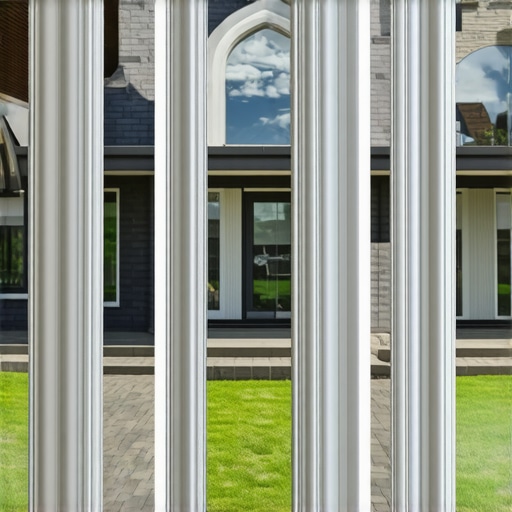
The Anatomy of a Failed Radius: Why Your Arched Window is a Liability
I recently walked into a high-end custom home where the owner was dealing with a ‘condensation crisis’ that most would blame on the manufacturer. They had these massive, beautiful arched windows overlooking the patio, and every morning, the lower sash was fogged to the point of opacity. I pulled out my hygrometer and a thermal imaging camera. It wasn’t just ‘lifestyle’ humidity; it was a systemic failure of the thermal envelope. The installer had treated the arched rough opening like a standard rectangle, ignoring the specific physics of curved geometry. The result? A massive thermal bridge where the shim space met the radius, cooling the glass below the dew point and turning a $5,000 window into a glorified humidifier. If you are planning an installation in 2026, you need to understand that an arched window is not just an aesthetic choice; it is a complex structural challenge that manages heat, light, and water in ways a standard horizontal slider window never will.
“Installation is just as critical as the window performance itself. A high-performance window installed poorly will fail.” – AAMA Installation Masters Guide
Mistake 1: The ‘Straight-Tape’ Flashing Disaster
Water follows the ‘Shingle Principle’—it always flows down and out. In a standard window, flashing is straightforward. But when you introduce a radius, the traditional method of using rigid flashing tape fails. I have seen hundreds of ‘caulk-and-walk’ installers try to ‘segment’ straight flashing tape around a curve. This creates tiny fish-mouth gaps at every overlap. In a heavy wind-driven rain, those gaps act like straws, sucking water directly into the header. By the time you see water on the sill, the structural header is already rotting. For a proper arched installation, you must use a flexible, high-performance flashing membrane or a liquid-applied flashing system that creates a continuous, monolithic barrier. Without a dedicated sill pan that is integrated into the drainage plane, that water has nowhere to go but your drywall. If your installer isn’t talking about the ‘Rough Opening’ tolerances and how they plan to bridge the radius with a flexible membrane, they are setting you up for a five-figure repair bill in less than a decade.
Mistake 2: Mismanaging the Solar Heat Gain Coefficient (SHGC)
In southern or high-sun climates, arched windows are often placed high on the wall where they receive direct, punishing solar radiation for eight hours a day. Homeowners often get seduced by the ‘Visible Transmittance’ (VT)—they want that bright, airy feel. However, ignoring the Solar Heat Gain Coefficient (SHGC) is a recipe for a localized greenhouse. I’ve seen decorative window grids and muntins literally warp because the heat trapped between the glass and a tight-fitting window covering had nowhere to go. To prevent this, you must specify argon gas filled windows with a Low-E coating on Surface #2. This is the outboard surface of the inner pane of glass. When long-wave infrared radiation (heat) hits that coating, it is reflected back outside before it can even enter the building’s thermal envelope. In 2026, we are seeing more homeowners opt for 90-minute fire windows in wildland-urban interfaces, which adds even more complexity to the glass weight and thermal stress. If you don’t balance the SHGC with proper ventilation, you aren’t just buying a window; you’re buying a radiator that you can’t turn off in July.
“The selection of glazing must be based on the specific climate zone and orientation of the building to ensure long-term durability and energy performance.” – NFRC Certification Standards
Mistake 3: Structural Neglect and ‘Shim’ Failure
An arched window is inherently heavy, especially if it’s a fixed unit designed to match a lift slide window replacement nearby. The weight of that glass doesn’t just sit on the bottom; it exerts outward pressure on the radius. Most installers use standard wood shims, which can compress or rot over time. I insist on high-density plastic shims placed at the ‘quarter points’ of the arch to maintain the structural integrity of the frame. If the frame shifts even 1/16th of an inch, the glazing bead can pop, and the argon gas fill will leak out. Once that gas is gone, the U-factor skyrockets, and your energy efficiency vanishes. We also see issues with aftermarket additions; a window bird feeder attachment might seem harmless, but on a large arched unit, that localized weight can stress the seal. Furthermore, maintenance is often overlooked. Items like window sweep replacement or window covering repair are treated as afterthoughts, but on an arch, these components are custom-fitted. If your window sweep fails, you lose the air seal, and the ‘chimney effect’ will pull cold air from the floor right out through the top of that beautiful arch.
The Technical Reality of Modern Glazing
Whether you are looking at fixed skylight services, dome skylight replacement, or a complex arched facade, the physics remain the same. You are managing the ‘Dew Point.’ In cold climates, we focus on the U-factor (keeping heat in) by using triple-pane glass and warm-edge spacers. These spacers, made of structural foam rather than aluminum, prevent the edge of the glass from becoming a cold spot that attracts condensation. In 2026, the ‘Energy Savings’ myth is finally being debunked—you don’t buy these windows for a 5-year ROI on your utility bill; you buy them for the thermal comfort that prevents a 2 AM draft. If your horizontal slider windows are whistling in the wind, it’s usually a failure of the pile weatherstripping, but if your arched window is leaking, it’s a failure of the fundamental installation science. Don’t let a ‘Tin Man’ salesman talk you into krypton-filled units for a climate that doesn’t need them. Buy the numbers, verify the ASTM E2112 installation protocol, and ensure your master glazier understands that the hole in your wall is an ecosystem that requires precise management.